Lawrence Wood Flooring has spent more than 20 years on wood-flooring in Melrose and across the region, and some of the hardest calls we take start with water rather than wear. A floor that has been under water, even briefly, needs a different order of work than a floor that is simply tired: dry it, measure it, then decide. Sanding or replacing too early locks the damage in.
Our approach after a flood or a leak is the same whether the water came from a storm, a burst pipe or the unit upstairs. We trace where it went, dry the floor and the subfloor under it, and read both with a moisture meter before any board is pulled or any finish is sanded off. Then we document each room for the adjuster and give you a written plan for what can be saved.
Plenty of the floors we see here are old, and old floors behave differently when wet. Red oak strip flooring, eastern white pine and other softwood flooring each swell, cup and recover in their own way, and the right repair depends on which one you have and how long it sat in water.
Ell Pond and the Water That Reached Melrose Buildings
Ell Pond is a 23-acre pond in the middle of Melrose, bordered by homes, streets, recreational fields and landscaped park strips. It drains an 1,100-acre watershed that reaches into parts of Stoneham and Wakefield, so rain falling outside the city limits still ends up in the pond. Water leaves through an outlet at the southeastern corner and runs south beneath city streets to Lower Spot Pond Brook.
For years the original outlet channel let water start draining only when the pond was nearly full, which meant the level could not be lowered ahead of a big storm. According to FEMA’s account of the project, runoff from several storms, most recently in 2006, led to flood depths as high as 6 feet in buildings, yards and streets to the north of Ell Pond. Melrose Emergency Management Director Ed Kelly described earlier floods in which large areas of central Melrose were underwater for as long as a week to 10 days.
Why Time in the Water Matters for a Floor
Depth gets the attention, but for a wood floor, time in the water decides most of the outcome. A board that gets wet and dries within a day or two often settles back with modest cupping. A floor that sits submerged for days soaks water through the tongue and groove, into the subfloor and up into the walls, and that is a different repair.
Floodwater also carries what it picked up on the way, from street runoff to whatever was stored on the floor. That is part of why a floor that sat in standing water for days gets judged more strictly than one wet by a clean supply line, even when the cupping looks the same.
Older Housing Near the Pond
Melrose’s housing leans old: 52.2 percent of its housing units were built in 1939 or earlier. Buildings of that era often have solid hardwood or softwood laid over board subfloors with cut nails, and many of those floors have been refinished more than once. How much wood is left above the tongue becomes a real question once water damage enters the picture.
Looking for wood-flooring closer to Saugus? See Wood-Flooring in Saugus.
What Floodwater Does to a Wood Floor
Wood takes on water from whichever side it touches, and it swells across the width of each board far more than along its length. The pattern of that swelling tells us a lot about what happened and what can be done.
Cupping, Crowning and Buckling
Cupping is the most common sign: the edges of each board rise above the center because the underside took on more moisture than the top. Crowning is the reverse, and it often shows up when a cupped floor was sanded flat before it dried, leaving the center high once the moisture finally leaves. Buckling, where boards lift right off the subfloor, means the swelling ran out of room at the walls and the expansion gap could not absorb it.
Delamination, Stains and Finish Damage
Engineered flooring adds a failure that solid hardwood does not have: the engineered wear layer can separate from its core once the glue lines soak through. Floodwater also leaves dark water stains where it reacts with the tannins in oak, and those sand out only if they have not gone deep. Older finishes such as shellac and wax turn white or cloudy where water sat, a cosmetic sign but a useful map of the damage.
What a Floor Usually Cannot Come Back From
Boards that have delaminated, rotted at the edges or stayed wet long enough to grow mold are replacement work. So is a floor whose subfloor has swollen or pulled loose from the joists, because no amount of sanding fixes what is underneath. When a floor turns bouncy or starts sloping after a flood, we refer the structural question out rather than covering it with new boards.
Drying Out Before Any Refinish or Replacement
The most expensive mistake after water damage is acting before the floor is dry. A cupped floor sanded flat while still wet will crown once it dries, and new boards installed over a wet subfloor will cup, gap or buckle within a season.
Reading the Floor With a Moisture Meter
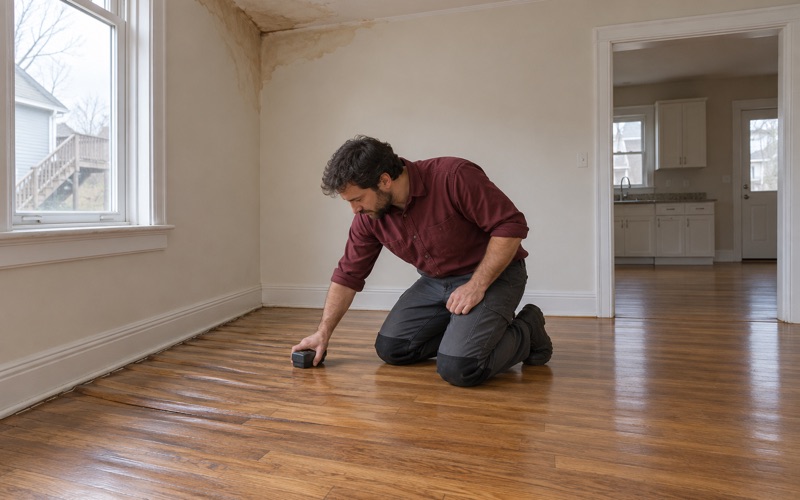
We take moisture meter readings across the damaged area and compare them with a dry reference board elsewhere in the same house, not just with a number on a chart. Readings go into the subfloor as well as the finished floor, because a dry surface over a wet subfloor is still a wet floor. We record them room by room, which also gives the adjuster something concrete to work from.
How Long Drying Takes
There is no fixed drying time. A floor that was wet for hours may come back into range within days with dehumidifiers and steady air movement, while one that sat under water for days can take weeks, especially behind plaster walls. We wait for the readings, and cupping often relaxes substantially on its own as the boards return to equilibrium with the room.
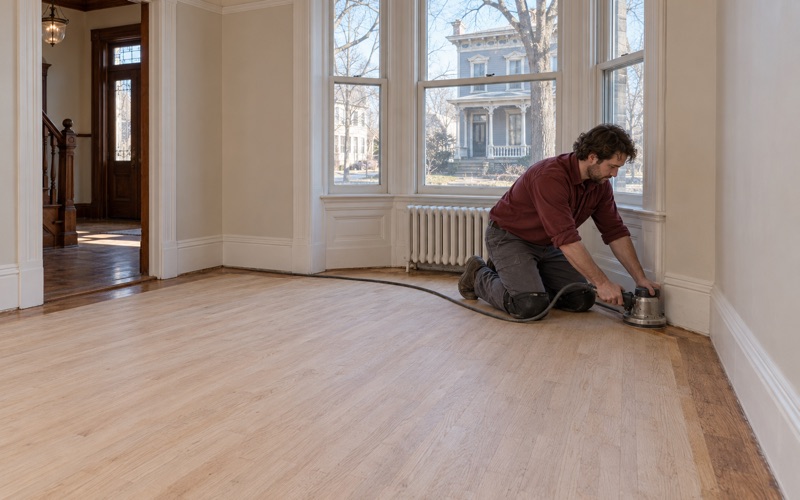
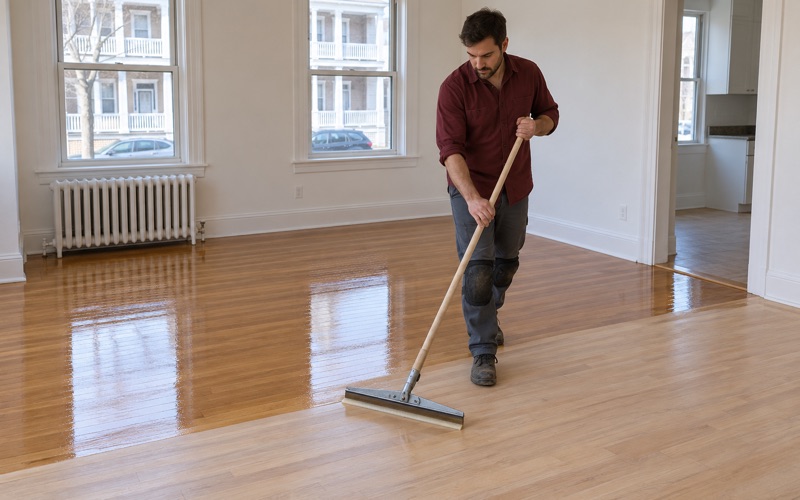
Once the readings are back in range, a floor with only light finish damage may need no more than a screen and recoat. Boards that kept a slight cup after drying usually need a full sanding with a drum sander, followed by a waterborne or oil-modified polyurethane chosen for the room.
Rental Units and the 48-Hour Rule
For landlords, the Massachusetts sanitary code adds a deadline. Under 105 CMR 410.500(B), after leaks and flooding the owner must ensure all surfaces have been dried within 48 hours from the time they are notified or the end of the event, whichever is sooner. The drying has to start right away, even though the decision to refinish or replace still waits for the meter.
When floor damage in a unit may be charged to a tenant, we write the itemized estimate Massachusetts expects a landlord to have first. If the flood hit between tenancies, we schedule drying, repair and finish around the move-out and move-in dates.
Saving, Patching or Replacing, and What Changed at Ell Pond
Once the floor is dry, the choice between saving, patching and replacing comes down to how much sound wood is left and whether the damage is local or widespread. We also weigh what the rest of the house has, because a repair that matches nothing around it is not worth paying for.
Patching Older Floors
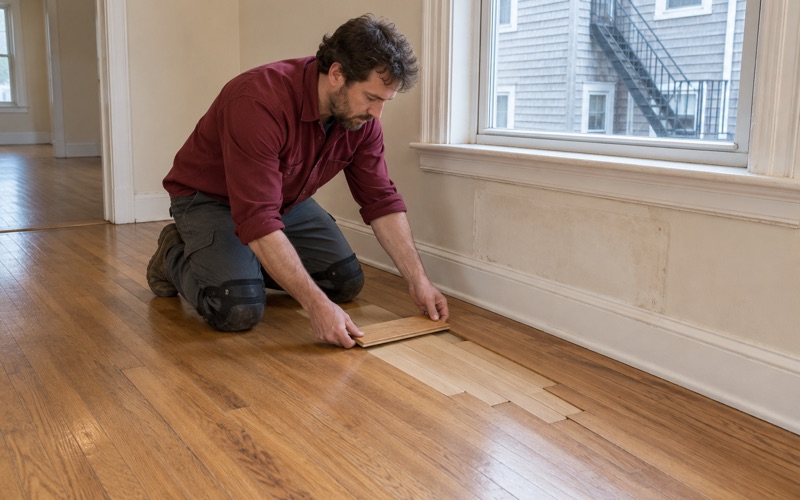
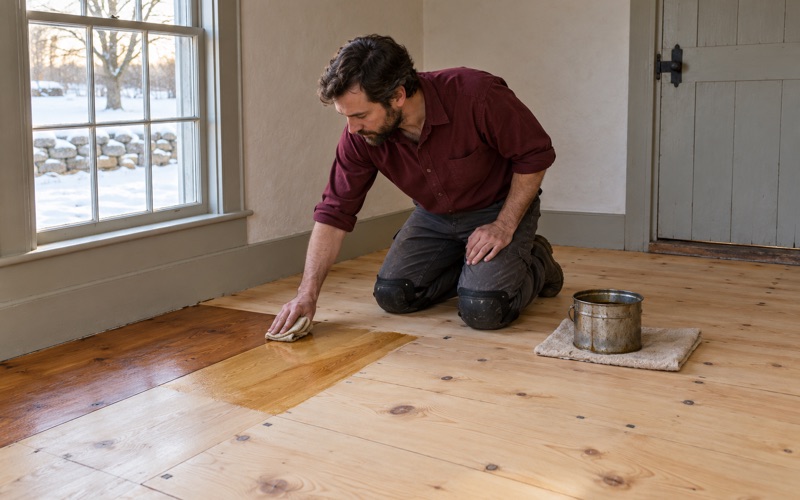
Where the damage is confined to one area, a weave-in repair replaces the ruined boards with matching stock woven into the surrounding floor, so the patch does not read as a rectangle. On old pine and other softwood floors we sand with the softer wood in mind rather than cutting it like oak, because an aggressive grit sequence can dish a pine floor that has already lost thickness to earlier refinishes. Before any sanding we check the build year and any painted surfaces, since Massachusetts runs its own lead-safe renovation rules for homes built before 1978.
When Replacement Makes More Sense
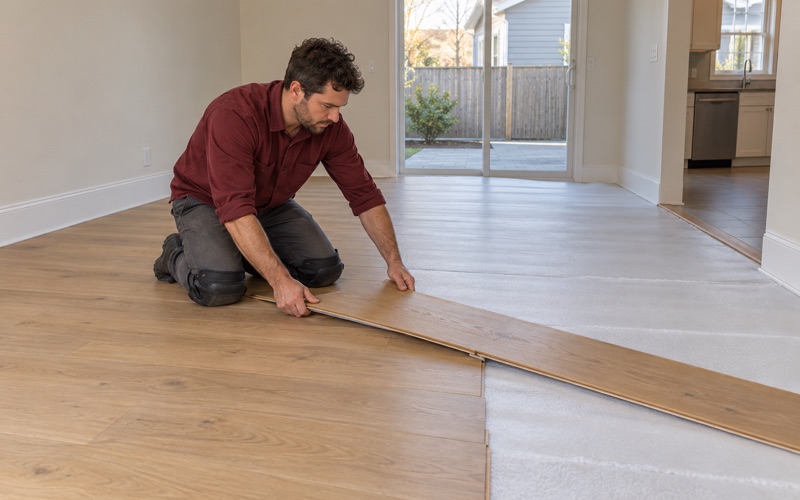
If water reached most of a room, or the wood above the tongue is too thin to survive another sanding, replacement is usually the honest answer. When old resilient tile and black mastic turn up under a damaged floor, we identify them and stop until the right trade has handled them rather than sanding through. New boards are acclimated to the house before installation, and we lay stain samples on the existing floor so the repaired area matches in your own light.
In a two- or three-family house, we work one floor at a time. The household on the other floor keeps living in the building while its neighbor’s floor dries and gets rebuilt.
How the Ell Pond Project Changed the Picture
After a 2001 study identified alternatives and the city sought funding in early 2005, Melrose built the Ell Pond Project with $1.75 million from FEMA’s Pre-Disaster Mitigation grant program, supplemented by city funds of $1 million. The work added a control gate at the pond’s southeastern corner and a 3,500-foot, 48-inch pipe running to Lower Spot Pond Brook, so the city can draw the pond down ahead of a storm instead of waiting for it to fill. In March 2010 that system moved water out at 100 cubic feet (748 gallons) each second.
The difference showed in 2010: by Kelly’s account, only scattered depressions near Ell Pond flooded, and the water drained away within a few hours to a few days at most. For a wood floor, that is often the line between a drying job and a replacement job. It does not mean water can no longer reach a building near the pond, and storms, burst pipes and the unit upstairs still bring us calls, but shorter time in the water leaves more floors that can be dried, read and saved.
- 20+ Years on Wood Floors
- Itemized Written Estimates
- Old Pine and Oak Work