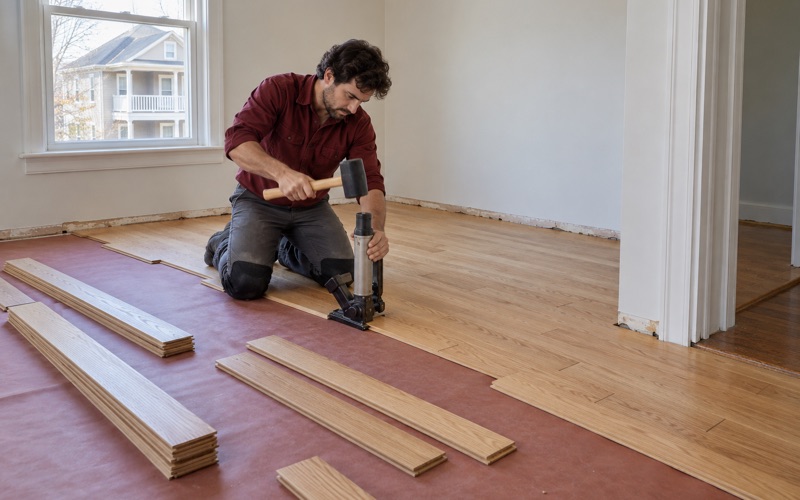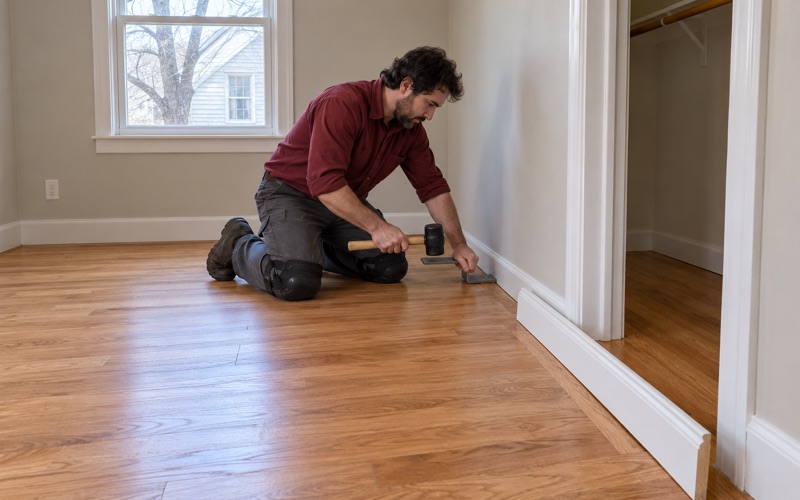
Lawrence Wood Flooring has handled wood-flooring in Newburyport for more than 20 years, and this page covers the floors that sit inside a unit rather than a whole house. A condominium, a townhouse or one floor of a divided older house adds a second set of decisions to a floor job: what the owner wants, and what the building’s own documents allow. We plan for both from the first visit.
That means reading the master deed and the association’s rules alongside the floor itself. Refinishing red oak strip flooring in a top-floor unit, replacing a water-stained section in a townhouse hallway, or laying solid hardwood where carpet used to be all touch shared walls, shared stairs and neighbors living a few feet away. The schedule, the dust control and the underlayment all follow from that.
Our estimates are written and itemized, stain samples go down on your own boards in your own light before a color is chosen, and the work is sequenced so the household on the other side of the wall keeps its routine as much as the job allows. Where the master deed or the rules say something about floors, we build the plan around it rather than around our habits.
Newburyport Condominiums, Townhouses and Their Documents
A City Where Many Owners Own a Unit
The census figures show how common unit ownership is here. Of Newburyport’s 6,279 owner households, 1,189 live in one-unit attached houses and 754 own in two-to-four-unit buildings, 468 of them two-unit and 286 three-or-four-unit, according to the 2024 five-year American Community Survey. The city counts 1,274 one-unit attached homes in all, and 77.5 percent of its occupied homes are owner-occupied.
Not all of those owners hold a condominium unit. An attached townhouse can be owned outright with its own lot, and an owner of a two-family may hold the whole building, so the first question we ask on a call is how the property is held. The answer decides whose documents we read before we quote.
A Local Conversion Bylaw on the Books
Newburyport is one of a short list of Massachusetts cities and towns named as having adopted their own condominium conversion bylaw or ordinance under Chapter 527 of the Acts of 1983, the state conversion statute. A 2012 New England Real Estate Journal article on the statute names Newburyport among them. Local laws of that kind deal with converting existing buildings into condominium units, which is one way a unit in an older building comes to exist.
We do not interpret the ordinance or summarize its terms here; questions about a conversion belong with the owner’s attorney or the city. What matters for a floor is the result. A converted building often carries original floors that were never planned with separate owners in mind, now governed by documents written long after the boards went down.
The Master Deed and Chapter 183A
Condominium form and association governance in Massachusetts fall under M.G.L. c.183A. The master deed describes the units and the common areas, and the association’s bylaws and rules sit under it. Where a unit ends and the common area begins can matter for a floor job, because the finished boards may belong to the owner while the subfloor and joists beneath them may not.
That line changes who decides. Sanding and refinishing inside the unit is often the owner’s call within the rules, while opening a subfloor or work near the joists can reach into common areas and need the association’s sign-off. We read the boundary language before we put a number on a repair that goes below the finished floor.
Looking for wood-flooring closer to Stoneham? See Wood-Flooring in Stoneham.
Reading the Association Rules Before a Floor Job
Association rules are where most of the practical limits on a unit floor job live. They are set by the association under its documents, not by the City of Newburyport, so two buildings on the same street can run on very different rules. We ask for the documents early, because a rule found after the floor is ordered costs more than one found at the estimate.
What We Ask to See
We ask for the master deed, the bylaws, the current rules and regulations, and any renovation or flooring policy the board has adopted. Some associations also keep a form for owners to file before work starts, or a list of hours when power tools may run. If the documents say nothing about floors, we tell you that plainly rather than reading a rule into them.
Whether the job needs anything from the City of Newburyport building department is a separate question from the association’s approval. We check that with the city for the actual scope of work instead of assuming an answer either way.
Carpet to Hardwood in an Upstairs Unit
A request that regularly runs into association rules is pulling wall-to-wall carpet in an upper unit and putting wood down. Carpet and its pad soften footsteps for the unit below, and bare hardwood carries impact noise much more readily. Condominium documents sometimes address this directly, and sometimes say nothing at all.
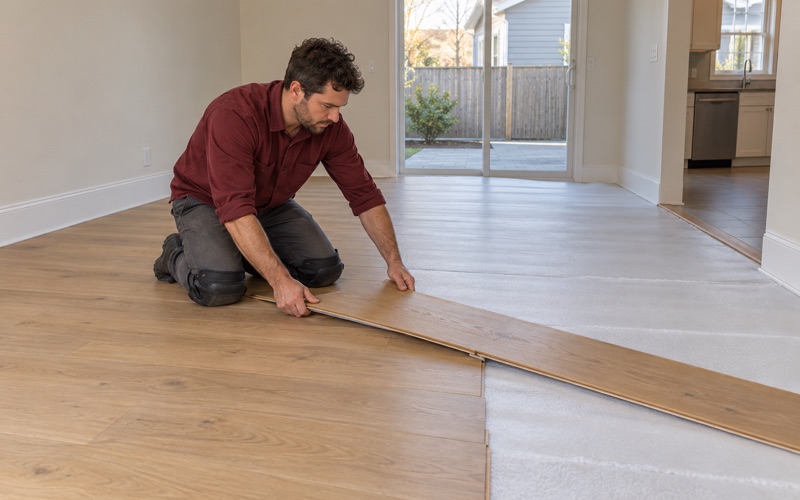
We talk through the underlayment and floor choices against what your building’s documents actually say. That can mean an acoustic underlayment under a floating engineered floor, a different assembly under nailed solid hardwood, or keeping carpet in a bedroom over a neighbor’s bedroom. Where the rules call for a specific product or a sound standard, the association sets that figure, and we work to what is written rather than quoting a number of our own.
Once the carpet, pad and tack strip come up, the floor under them tells us what the job really is. Old carpet glue, staple rows, pet urine stains and water stains near a radiator all show up then, and so do boards that were never finished because carpet always covered them. We hold the refinish price open until that reveal, and say so in the estimate.
Converted Older Houses and Their Shared Floors
Newburyport’s housing is old: 3,913 of its 8,710 housing units were built in 1939 or earlier. When a house of that age is divided into units, floors laid for one household end up serving two or three. Board runs can continue under walls added later, a front hall can become a common entry, and a stair that once served one family may now be shared.
Floors That Cross Unit Lines
A continuous floor that runs from a unit into a common hallway raises a practical question: where does our refinish stop? Stopping mid-run leaves a visible line, so we look at where a threshold or reducer can sit cleanly and confirm with the association whether the hallway side is theirs to decide. In two- and three-unit buildings we work one floor at a time, so the owner upstairs or downstairs keeps living in the building while the job goes on.
Old Softwood, Radiator Patches and Weave-Ins
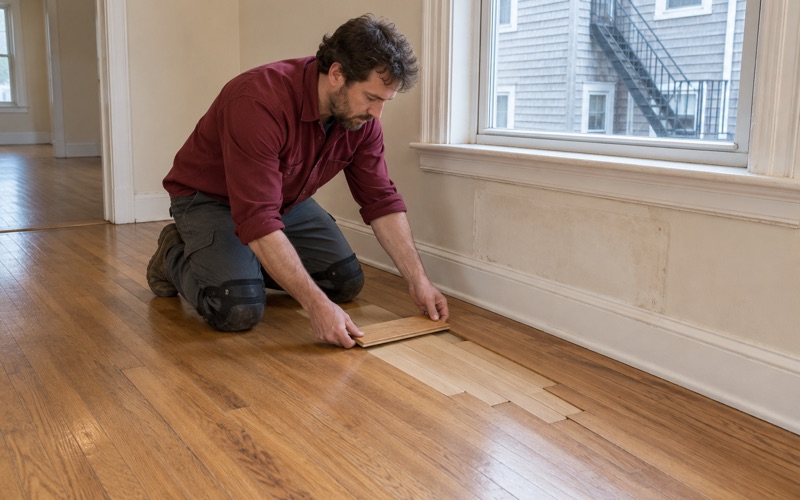
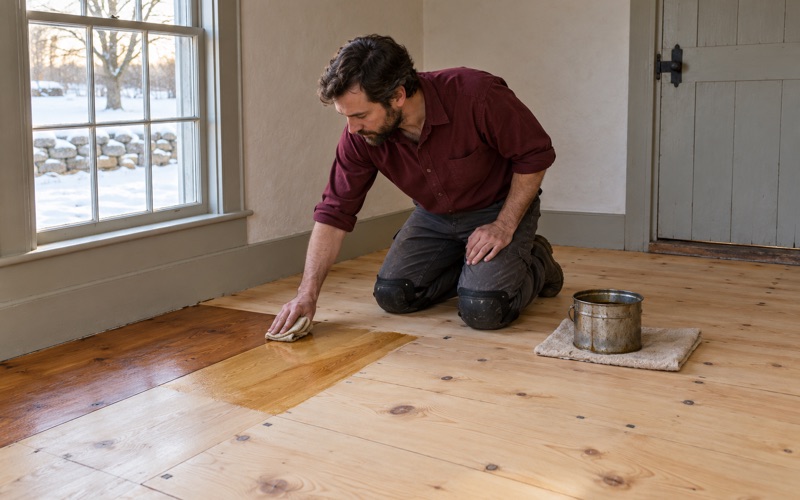
Older floors here may be eastern white pine, southern yellow pine or heart pine rather than oak, and softwood flooring dents and sands away faster than red oak. We refinish it with that softness in mind, choosing a gentler grit sequence and taking off as little wood as the floor allows. Where a radiator and its pipes came out during a conversion, we patch the holes with matching boards woven into the floor instead of a square plug.
Lead Paint and Old Tile
Massachusetts runs its own lead-safe renovation rules for homes built before 1978, so we check the build year and any painted surfaces before a sander touches the floor. Painted floors, painted stair risers and painted trim at the edges turn up in houses of this age, and in a shared building the dust question reaches the neighbors too. Old resilient tile and the black mastic beneath it are another stop: we identify them rather than sand them, and the work waits until the right trade has handled the material.
Sound, Scheduling and Planning a Unit Floor Project
A floor job in a unit is also a job in a building full of other people. The plan we write covers how loud the work gets and when, where the dust goes, how long rooms stay out of use and how the finish smells while it cures.
Noise, Dust and Work Hours
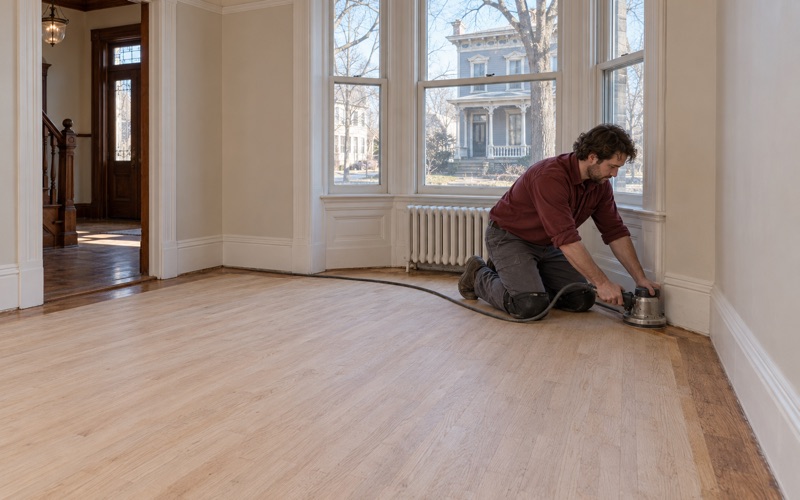
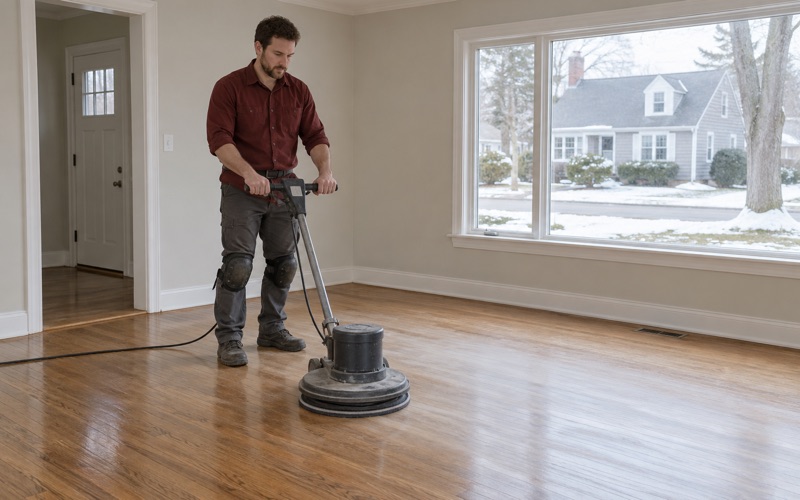
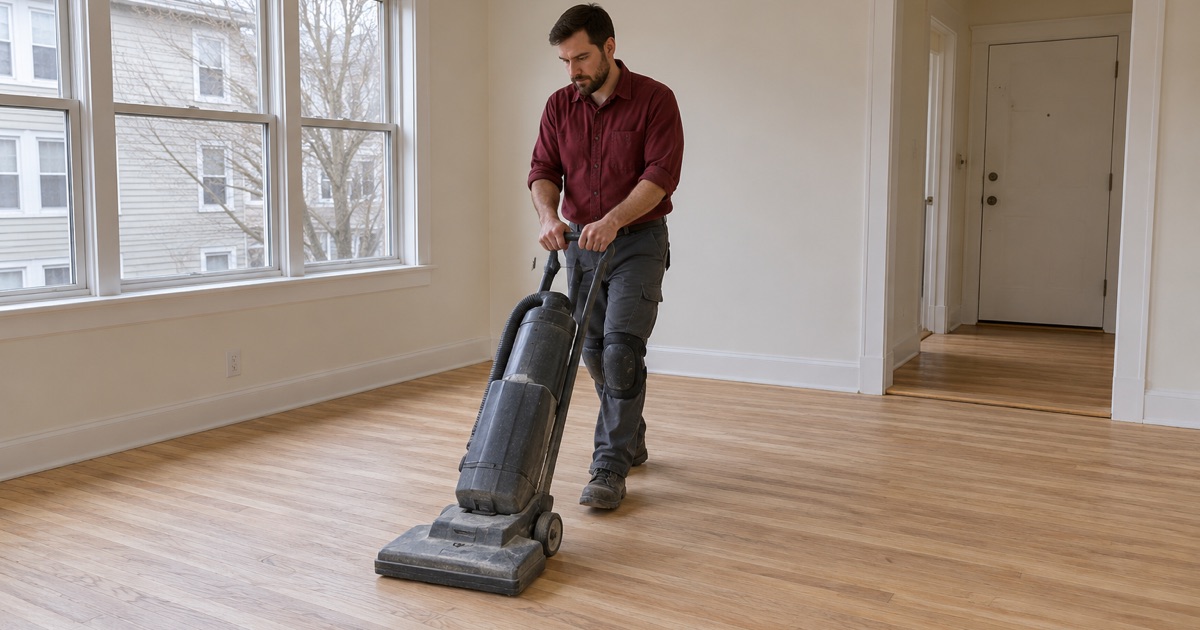
A drum sander and an orbital sander are loud, and the sound travels through shared walls and floors. Work hours, quiet days and notice to neighbors, where a building has them, are set by the association, and we schedule the sanding days around them. For dust, we run dustless sanding with HEPA vacuum collection and keep the common hallway clear and covered where the rules allow.
Finish Choice in a Shared Building
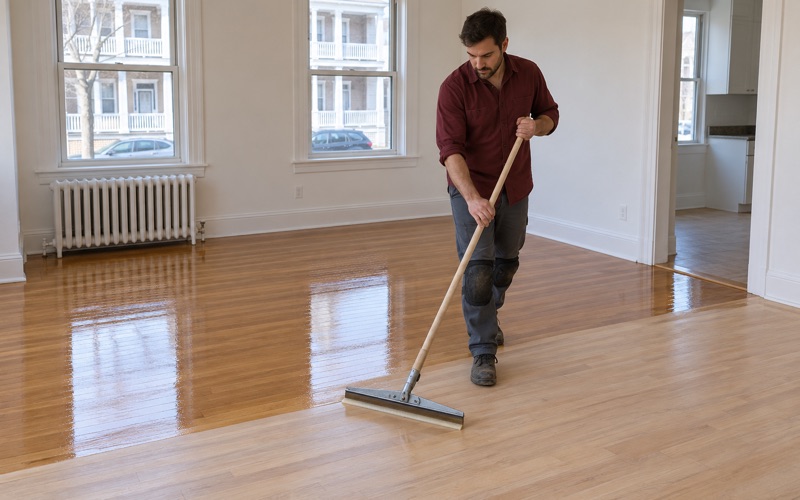
Finish choice matters more when the neighbors share your air. Waterborne polyurethane carries less odor and recoats faster than an oil-modified polyurethane, and a hardwax oil suits owners who want a low-sheen look they can spot-repair later. We pick from finishes that meet the coating VOC limits for varnish, sealer and lacquer on both sides of the state line, and we set the sheen level and stain color with you on your own floor.
Water From the Unit Upstairs
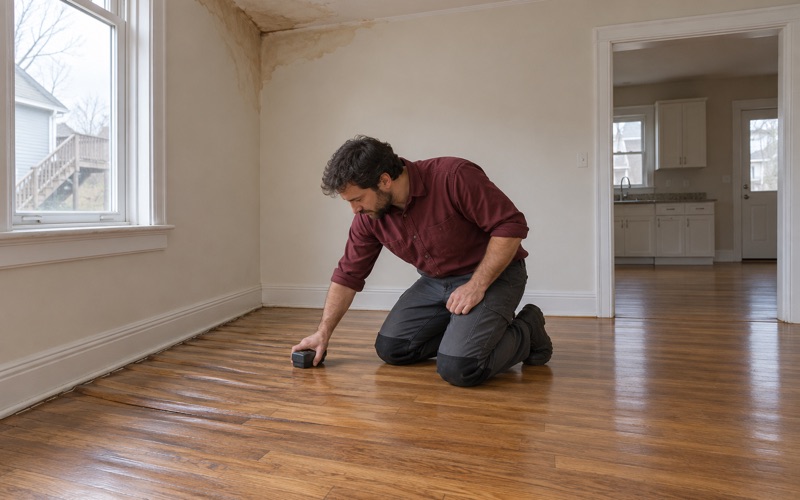
Stacked units share plumbing, and water from the unit above shows up in a floor as cupping, crowning or dark water stains along the boards. We trace the source, dry the floor and read it with a moisture meter before replacing a single board, because new boards laid over a wet subfloor can cup or buckle. Who covers which part of the damage can be split between the association’s policy and the unit owner’s, so we document the floor room by room for whichever adjuster is handling it.
Townhouse Stairs and Planning the Job
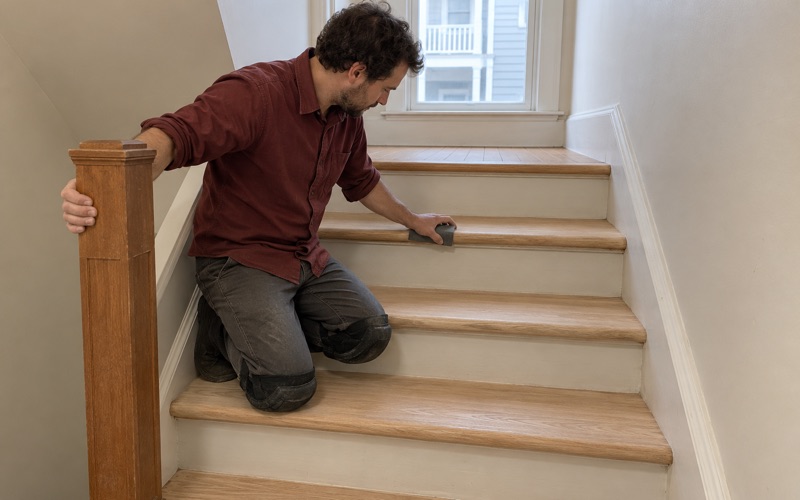
Many townhouses have interior stairs, and we quote them tread by tread, since a staircase is not priced by the square foot. Worn treads can be refinished with the floors they connect or covered with a retread, and the stair nosing is matched to the floor at the landing.
A unit floor project with us starts with the documents and a visit, then a written estimate that separates the floor work from anything that needs the association’s approval. From there we set dates that fit the building’s rules and your own schedule, and we keep the board informed when the documents ask for it.
- 20+ Years on Wood Floors
- Itemized Written Estimates
- Old Pine and Oak Work