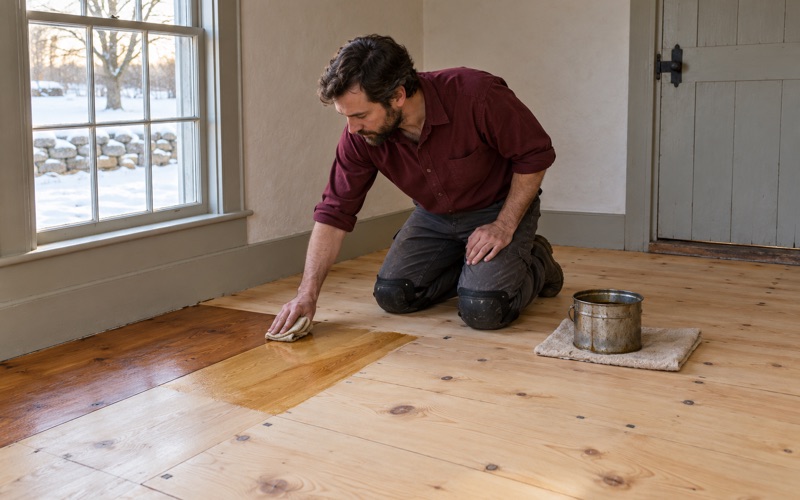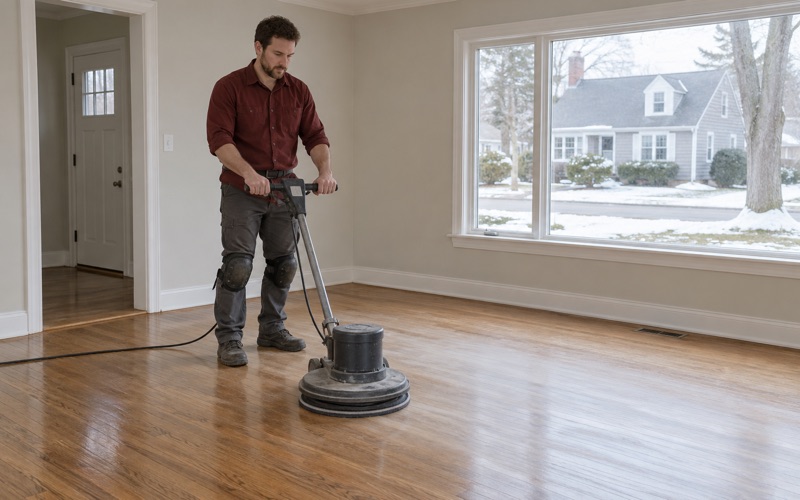
Lawrence Wood Flooring has spent more than 20 years on wood-flooring in Reading and across the towns near our Lawrence shop, and most of the Reading work we take on is getting existing floors ready for what comes next. A house about to be listed, a house a buyer has just closed on, a house a parent is passing to grown children: each one needs floors that can be lived on without starting over. We refinish, repair and replace boards in homes that already stand.
That kind of work starts with reading the floor before pricing it. We check the build year and any painted trim before a sander comes out, we look for old resilient tile and the black mastic under it, and we lay stain samples on your own boards so you judge color in your own light. Every estimate arrives in writing, itemized line by line.
Below we cover what Reading’s own housing plan says about the homes already here, what it takes to bring a quiet house back into use, how the town’s construction eras shape sanding and finishing, and how to time the work around a closing or a move-in. None of it begins with tearing a floor out.
What Reading’s Housing Plan Means for the Homes Already Here
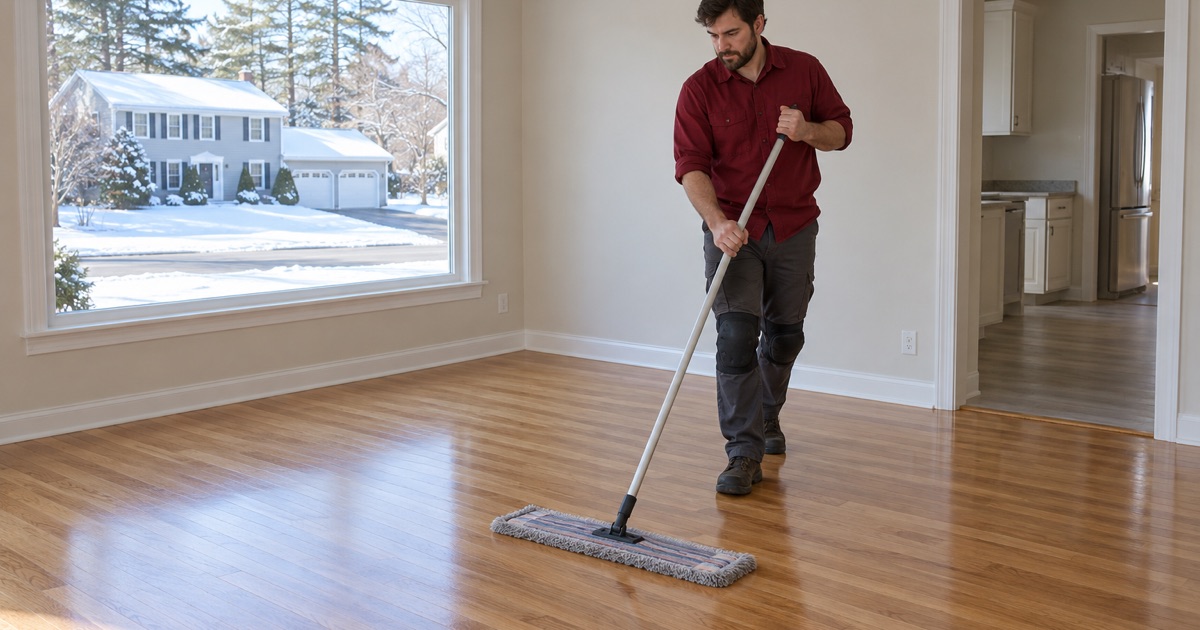
Reading has written down how it intends to house people, and the starting point is the stock it already has. The town’s 2023 Housing Production Plan, approved by the state in March 2023, counted 10.5 percent of Reading’s housing as affordable, which puts the town above the state’s 10 percent threshold. These plans are updated every five years, and this one replaced a plan that had been approved in 2018.
What 753 Residents Pointed Toward
The plan drew a resident survey of 753 responses, and rehabilitating vacant properties was one of the approaches those residents supported. Building on town-owned land and mixed-use buildings were on that list too, and the plan also addresses an aging population. Nothing we have read says the town pays for that work, so we price it as a private job and leave program questions to Reading’s planning staff.
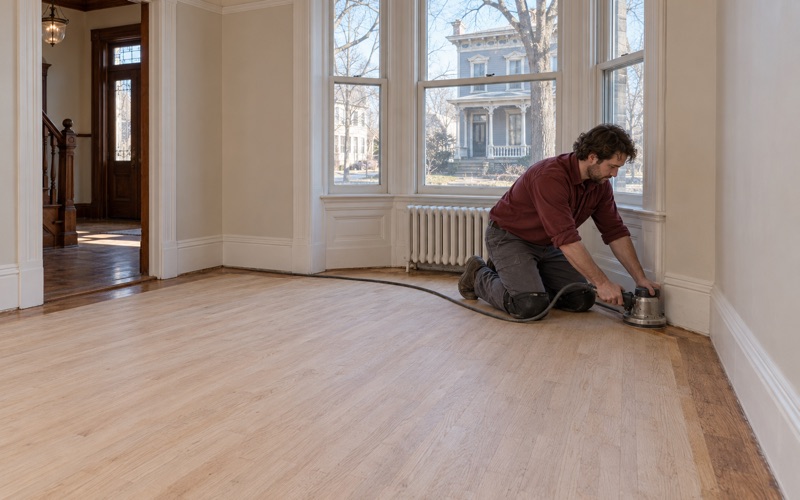
What rehabilitation means on the inside of a house is often the floors. A home that sat empty or went years without much attention can carry dull finish, gray traffic lanes, water stains by the doors and sun fade under every window, and much of that comes out with sanding rather than demolition. Keeping the original boards is often the less costly path and the one that respects what the house already is.
Who Decides on the Floors
Most Reading homes are owned by the people living in them. Census estimates count 8,028 of the town’s 9,740 households as owners, and 7,085 of its 9,951 housing units are single-family detached houses. In practice that means the person we talk to is usually the one who will live with the floor, or the one handing the house to whoever comes next.
Owners in the town’s larger buildings face a different question. When a unit sits above a neighbor, we talk through underlayment and acoustic choices against what the building’s condominium documents say before any flooring is ordered, since impact noise is what a downstairs neighbor hears first.
Looking for wood-flooring closer to Pinehurst? See Pinehurst Wood-Flooring.
Bringing a Quiet or Long-Held Reading House Back Into Use
A house that has been empty, or lived in by one family for decades, tends to hide its floors. Wall-to-wall carpet went down over a lot of good hardwood in the second half of the last century, and pulling it up is where the real estimate begins.
Under the Carpet
Once the carpet and carpet pad are out, we pull the tack strip, lift the staples and patch the nail holes the strip leaves at the walls. Then we look at what the carpet was hiding: pet urine stains that have gone black in the grain, carpet glue in spots, and boards that faded unevenly where furniture sat for years. Light surface marks sand out, while urine that has soaked deep into the wood usually calls for board replacement.
Replacing Boards Without a Patchwork Look
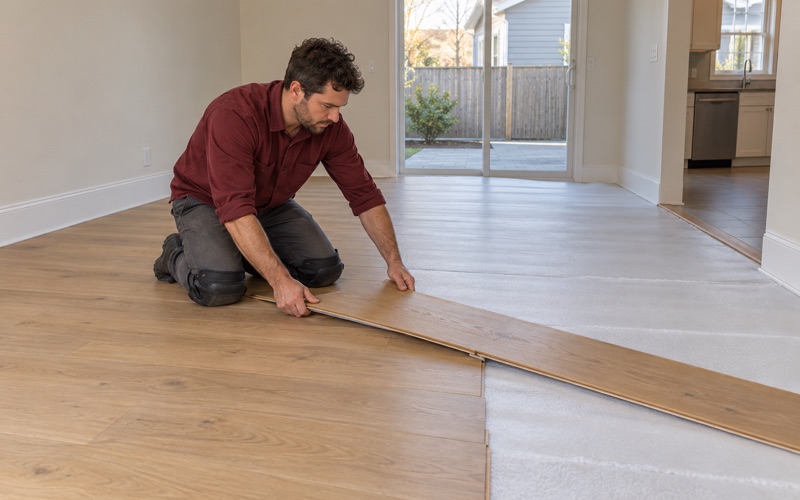
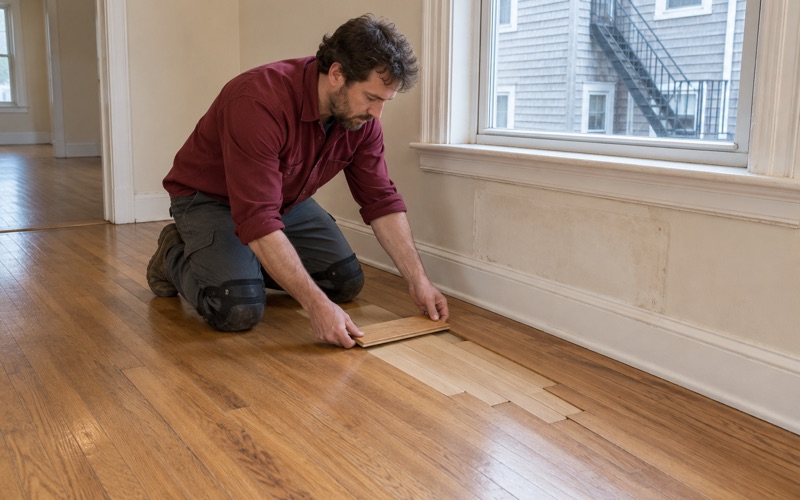
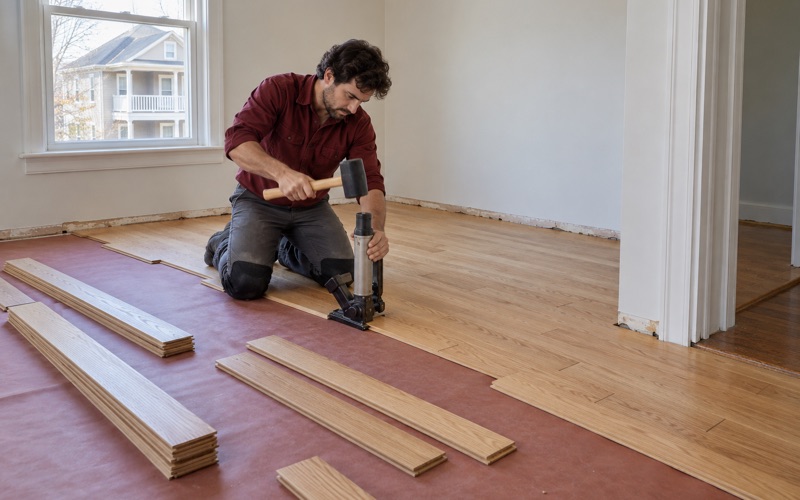
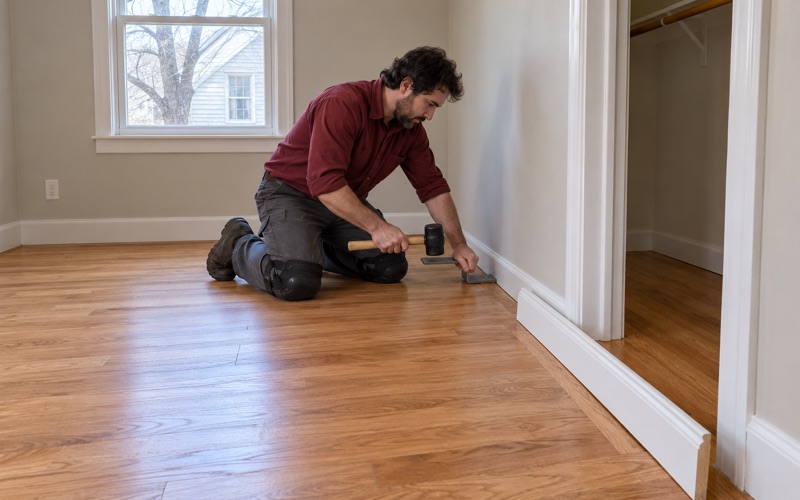
When boards have to come out, we weave new ones into the existing field rather than cutting a straight-edged square that reads as a patch from across the room. Each replacement is staggered into the surrounding courses, matched for species and width, and sanded in with the rest so the finish ties it together. The same weave-in repair handles old floor-register openings and the gaps left where a wall or a built-in once stood.
Water Before Wood
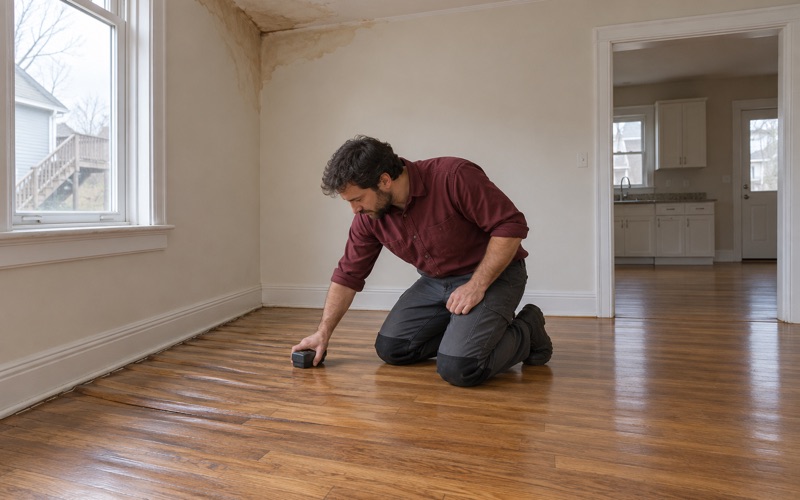
A vacant house can sit through a burst pipe or a wet basement nobody noticed for weeks. Before we replace a single board, we trace where the water came from, dry the area and read the floor and subfloor with a moisture meter, because new wood laid over damp framing can cup, crown or buckle. If an insurance claim is involved, we document the damage room by room for the adjuster.
A floor that bounces or slopes gets a different answer. We read it for what it is, and when the cause sits in a joist or the framing below, we refer the structural work out rather than sanding over a problem that will come back.
Refinishing Floors in Reading’s Prewar and Mid-Century Houses
Reading’s housing leans old. Census estimates put 5,039 of the town’s units, 50.6 percent, as built before 1960, and 2,679 of them, 26.9 percent, before 1940. Since 1940, the 1950s and 1960s were the two biggest building decades, with 1,472 and 1,316 units, so houses from those twenty years make up a large part of the town’s stock.
Strip Oak From the 1950s and 1960s
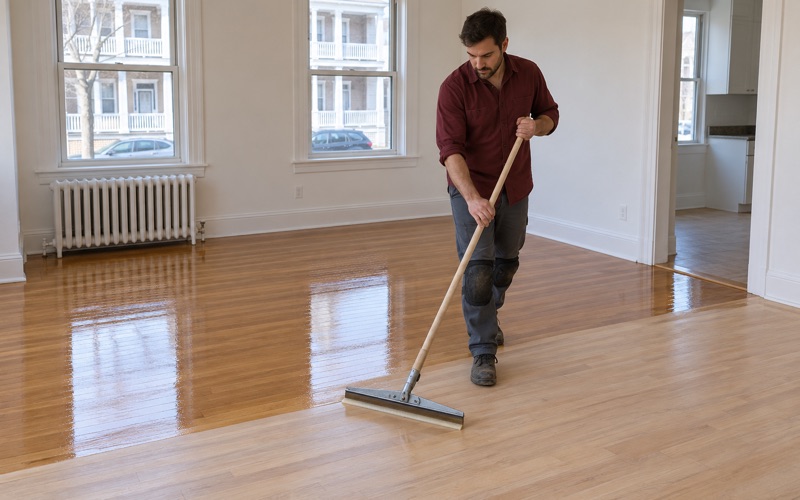
Many houses from that period went up with red oak strip flooring nailed tongue and groove over a board or plywood subfloor. Decades under an oil-modified polyurethane or older varnish often turn that oak a deep orange, and owners readying a house for a sale frequently want it brought back to a lighter, more neutral tone. A full sand with a proper grit sequence takes the old finish and the color down to bare wood, and a waterborne polyurethane ambers far less as it ages.
Kitchens and baths from those decades are where we slow down. Old resilient tile, and the black mastic or linoleum glue beneath it, can contain asbestos, so we identify it rather than sand it, and we stop the job until the right trade has handled it.
Prewar Floors Need a Lighter Hand
Houses built before 1940 can carry a wider mix: narrow oak, maple, and softwood flooring such as eastern white pine or southern yellow pine, often in upstairs rooms and back halls. Eastern white pine is far softer than oak, and a drum sander run the way it would be on oak can gouge it badly, so we adjust the machine, the paper and the passes to the wood in front of us. Some of these floors still carry a shellac finish or decades of wax residue, both of which have to come off cleanly before any modern coating will bond.
Painted surfaces matter here too. Massachusetts runs its own lead-safe renovation rules for homes built before 1978, so we confirm the build year and check painted trim, thresholds and stair parts before sanding begins, and we plan dust control around what we find. Dustless sanding with a HEPA vacuum cuts down the dust that reaches the rest of the house.
Timing Floor Work in Reading Around a Sale or a Move-In
Floors are among the last things a buyer sees before making an offer and among the first things a new owner wants done before the boxes arrive. The order of work around those two dates decides how much disruption the floor job causes.
Before the Listing
If the floor is sound and the finish is only worn, a screen and recoat can freshen it in far less time than a full sand. If there are worn-through paths, deep scratches or a color the house has outgrown, a full refinish is worth scheduling early, after painting and before staging, so the floor is cured and furniture can go back on it. We also help settle the sheen level, since a lower sheen hides everyday wear better than a high gloss.
Between the Closing and the Move-In
An empty house between closing and move-in is the simplest floor job there is. With no furniture to shift, we can sand every room in one pass, test stain colors on the boards themselves, and let the finish cure without anyone walking on it. We build the schedule backward from the moving date so the floors are ready when the truck is.
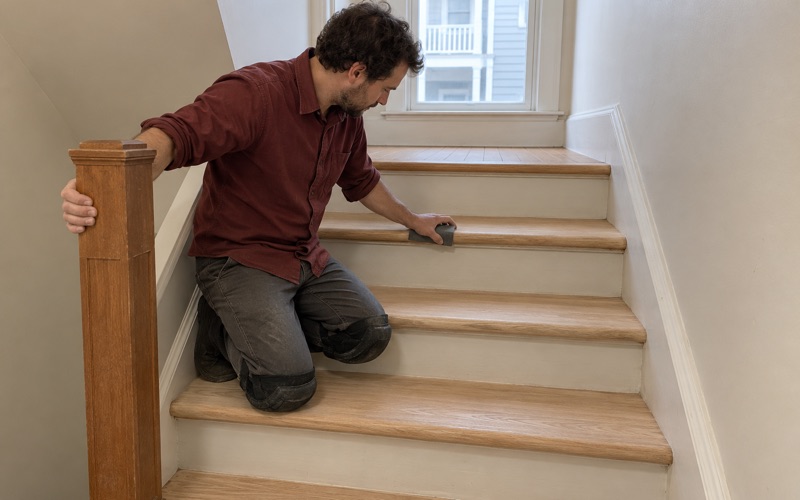
Stairs get their own line on the estimate. We price them tread by tread, because a staircase does not behave like open floor, and worn treads can be sanded, retreaded or replaced along with the stair nosing and risers to match the floor they lead to.
When the House Stays in the Family
Not every Reading house is changing hands. Some are staying with the family that has owned them for decades, sometimes because a parent is aging in place and sometimes because a son or daughter is moving in. For those homes we often work a few rooms at a time, so the household keeps a bedroom, a kitchen path and a way up the stairs while the rest of the floor is sanded and finished.
Whichever way the house is headed, the estimate you get from us lists each room, each repair and each staircase separately. That lets an owner decide what to do now, what can wait for the next owner, and what simply needs a fresh coat.
- 20+ Years on Wood Floors
- Itemized Written Estimates
- Old Pine and Oak Work