
Lawrence Wood Flooring offers screen and recoat hardwood floors service in Lawrence, MA, serving surrounding cities including Methuen, Andover, Haverhill, Lowell, Boxford. After 20+ years on wood floors, we can tell you quickly whether a dull floor needs a full sanding or whether a screen and recoat will bring it back for far less time, dust and cost.
A screen and recoat lightly abrades the existing finish and lays down a fresh coat of polyurethane. It does not touch the wood itself, so it works only when the old finish is still intact. Done at the right time, it can keep a floor looking good for years and push a full sanding far into the future.
We test the floor before quoting, because a recoat over the wrong surface can peel within weeks. If the floor needs more than a recoat, we tell you, and the written estimate shows both options side by side.
When a Screen and Recoat Is the Right Choice
Dull, Lightly Scratched Finish
The best candidate is a floor whose finish has gone dull and picked up fine scratches but still covers the wood everywhere. Light surface scratches from everyday living, chair legs and pets usually sit in the finish, and a recoat fills and refreshes that layer.
If you can see bare wood, gray patches or stains in the wood itself, the finish has worn through in those areas. At that point a recoat only seals the damage in, and the floor needs a full sanding.
Before the Finish Wears Through
The biggest benefit of a screen and recoat is timing. Every full sanding removes some wood from the floor, and a solid floor can only be sanded so many times. Recoating before the finish wears through extends the life of the floor and avoids sanding it before it is necessary. That makes recoating especially valuable on floors that have already been sanded several times, on engineered floors with a thin wear layer and on soft pine.
Rentals and Quick Turnarounds
For rental units, a screen and recoat is often the best option between tenants. It is faster than a full sanding, involves much less dust and lets the unit be shown and rented sooner.
We schedule rental recoats around the move-out and move-in dates, and we tell you honestly when the floor has worn too far for a recoat to hold up through another tenancy.
When a Recoat Will Not Work
Wax and Old Finishes
Polyurethane will not bond to wax residue, and some older finishes such as shellac or certain oils can prevent a new coat from adhering. Many older homes have floors that were waxed for years, even if they were later coated.
We test the existing finish before quoting a recoat. If wax is present, the floor needs the wax removed or a full sanding before a new finish can go down.
Floors Treated With Polish or Cleaners
Some household polishes and cleaners leave a residue that interferes with a new coat. We ask what products have been used on the floor and test the bond on a small area, because a recoat that peels is worse than not recoating at all.
Deep Scratches, Stains and Gaps
Deep gouges, pet urine stains, water stains and sun fade go into the wood, not just the finish. A recoat cannot remove them, and those floors need repairs and sanding instead.
Where a floor has a few damaged boards but is otherwise sound, we can sometimes replace those boards and recoat the rest. We explain whether that combination will give a result you will be happy with before recommending it.
How a Screen and Recoat Is Done
Cleaning and Testing
We start by cleaning the floor thoroughly, because any dirt, grease or residue left on the surface will be trapped under the new coat. Then we test the existing finish for wax and adhesion in a small area.
Furniture comes out of the room, and we check for raised nails, loose boards or squeaks that should be fixed first. A recoat does not hide a loose board, and fastening it afterward would mark the new finish.
Screening the Old Finish
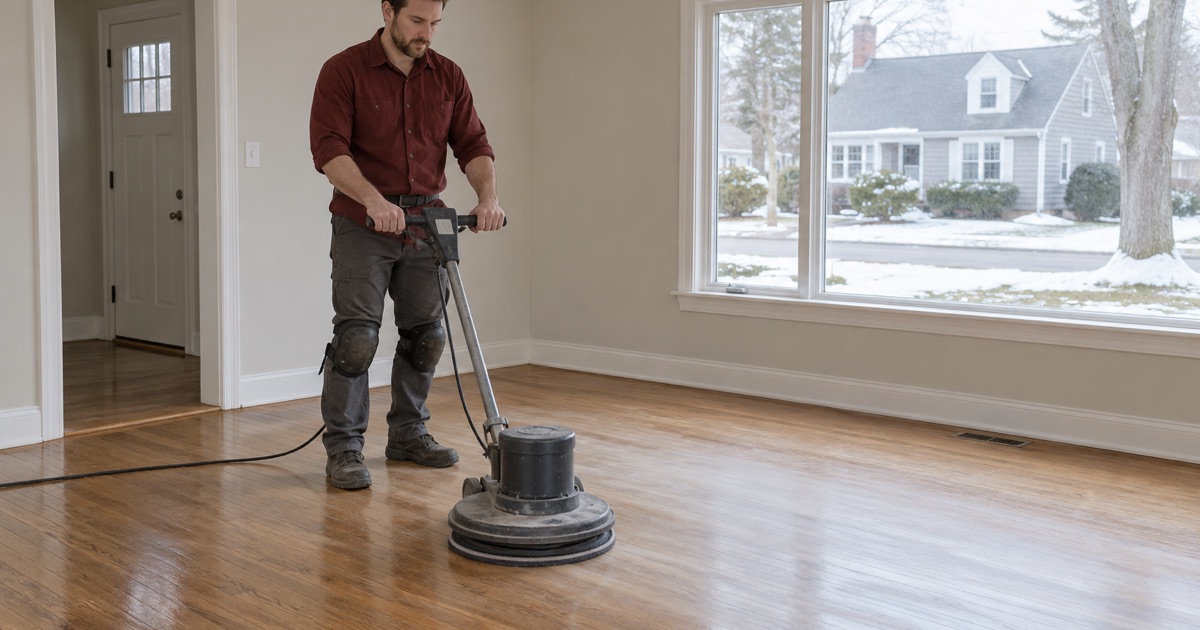
The floor is buffed with a fine screen or pad that roughens the top layer of the existing finish. This gives the new coat something to grip without cutting into the wood. Dust from screening is fine and minimal compared with sanding, and we vacuum it with HEPA vacuums and tack the floor before any finish goes down.
Applying the New Coat
A fresh coat of polyurethane is applied across the whole floor. Waterborne polyurethane dries quickly, stays clear and has low odor, while oil-modified polyurethane gives a warmer, deeper tone.
We match the sheen level to what you have or to what you want now. Changing from gloss to satin, for example, is easy to do during a recoat.
Recoating Different Types of Floors
Prefinished and Engineered Floors
Many prefinished floors have tough factory finishes that need specific preparation before a new coat will bond. We follow the manufacturer’s recommendations and test first, so the recoat holds. Recoating is often the safest maintenance for engineered floors, since it refreshes the surface without reducing the engineered wear layer.
Stairs
Stairs wear fastest at the nosing and in the center of each tread. A recoat on stairs is quoted tread by tread and is a good way to refresh them between full refinishes, as long as the finish on the nosing has not worn through.
Floors in Two-Family Houses
In a two- or three-family house, a recoat is one of the least disruptive kinds of floor work, because screening makes far less dust and noise than sanding. We still work one unit at a time and keep the shared stairway usable, so the other household barely notices the job.
- 20+ Years on Wood Floors
- Itemized Written Estimates
- Old Pine and Oak Work