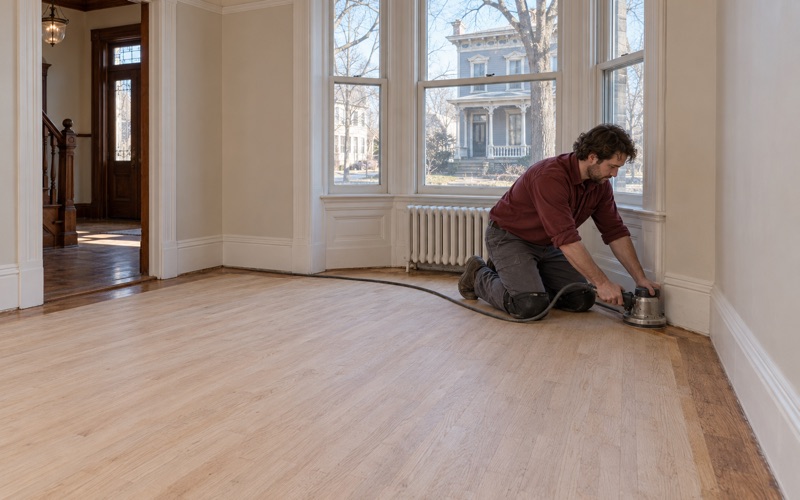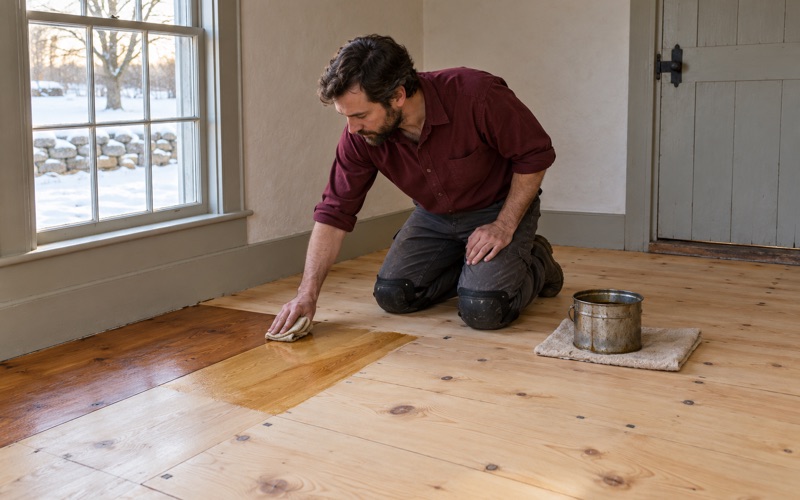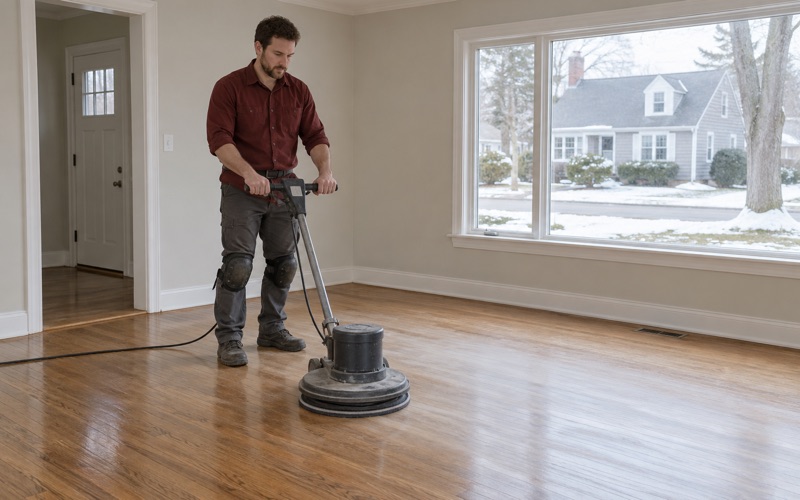
Lawrence Wood Flooring has spent more than 20 years on wood-flooring in Wilmington and nearby towns, and the work here is almost always for the person who owns the house and lives in it. We sand and refinish worn floors, weave new boards into old ones, rebuild stair treads and lay new solid or engineered floors. Each job starts with a walk through the rooms and a written estimate that names every room, every stair and every repair separately.
That owner-by-owner pattern shapes how we schedule. An occupied house means furniture moved in stages, a kitchen kept usable when we can manage it, and dust held down with dustless sanding and a HEPA vacuum rather than tracked through every bedroom. We plan the order of rooms with you before the first drum sander comes off the truck.
We also take the house as it is rather than as a catalog says it should be. A floor can be red oak strip flooring in one room, maple in the next and a newer engineered wear layer in an addition, and each one gets its own plan for sanding, finish and repair.
Floors in a Town of Owned, Detached Houses
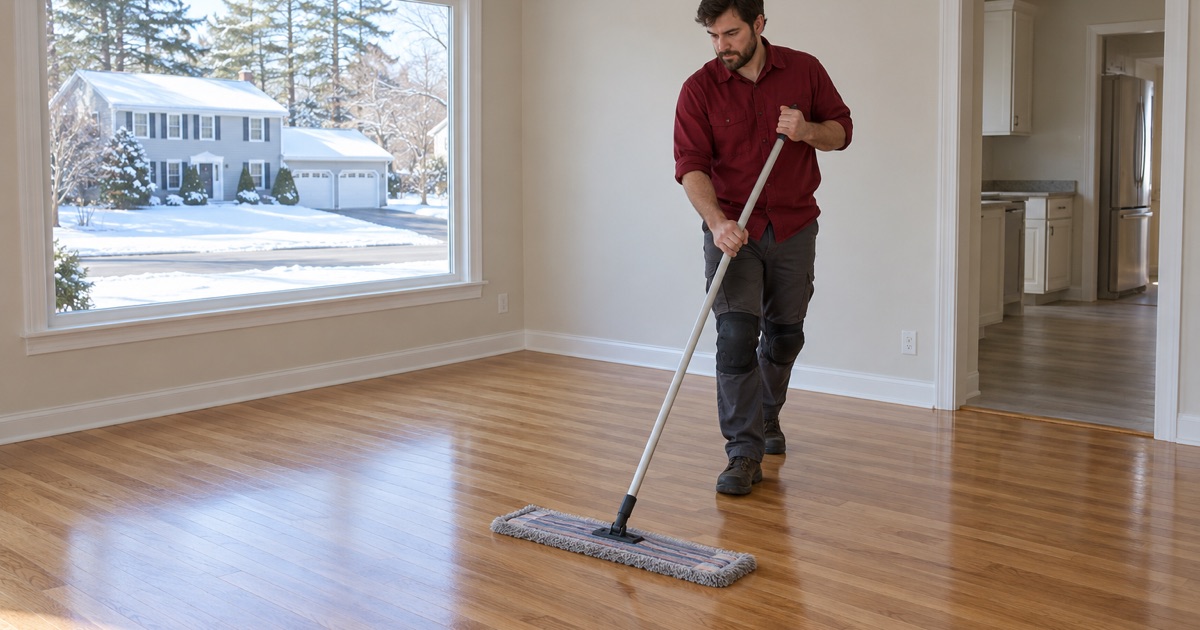
Wilmington has made a public choice about what kind of town it stays. Town Meeting rejected the state’s MBTA Communities multifamily overlay at the 2024 annual meeting, rejected the same district again at a December 2024 special Town Meeting, and voted it down a third time on May 3, 2025, 152 in favor and 162 against. The state’s requirement, as the Town Crier reported it, was a district of at least 50 acres, half of it within a half-mile of a train station, with a unit capacity of 1,248 on the state’s own model.
The dispute did not end there. On January 29, 2026, the Attorney General filed suit against Wilmington and eight other towns, asking the court to order a compliant zoning district and a compliance application. In January 2026, Town Manager Eric Slagle told Boston.com, “I don’t anticipate the town’s going to do anything affirmatively until and unless the state acts.” The case had no reported outcome when this page was written, and we make no prediction about it.
What the Votes Kept
Whatever happens in court, the housing those votes protected is easy to describe. Of Wilmington’s 8,077 housing units, 6,822 are single-family detached houses, according to the Census Bureau’s 2024 five-year American Community Survey. Of 7,926 occupied households, 6,979 own their home, which is 88.1 percent, and 95.1 percent of those owner households live in a detached house. That is the housing stock this page is about: existing houses, mostly owned by the people living in them, rather than new apartment buildings.
Why That Matters for Floor Work
For us, those numbers describe the job before we see it. The typical Wilmington call is a homeowner deciding on their own floors, on their own budget and timeline, with no landlord, condominium board or tenant in the middle of the decision. That makes room for choices that take longer, like stain samples left down for a few days or a full sand instead of a quick screen and recoat.
The town does have renters, and we work for them and their landlords too. Of 947 renter households, 305 live in buildings of ten to nineteen units and 163 in buildings of fifty or more, and turnover work there follows the building’s own rules and the move-out and move-in dates.
Looking for wood-flooring closer to Topsfield? See Wood-Flooring in Topsfield.
Wilmington Houses by Decade: 1950s, 1960s and 1990s
No single building era runs Wilmington’s housing. The largest decade in the Census count is the 1990s, with 1,504 units, followed by the 1950s at 1,265 and the 1960s at 1,032. Another 627 units were built in 1939 or earlier, and 1,603 have gone up since 2000, so floors across town were put down decades apart.
Wikipedia notes that Wilmington’s population has quadrupled since World War II. The large 1950s and 1960s counts sit inside that postwar growth, and the spread of eras is why we treat each house as its own floor history rather than assuming one kind of board for the whole town.
Postwar Strip Floors
When we find narrow strip flooring nailed through the tongue in a 1950s or 1960s house, we first read how many sandings it has left. Pet urine stains, water stains and traffic lanes near the doors are the usual wear, and old wax residue or carpet glue under removed wall-to-wall changes what the sander has to do first. Where carpet came up, we pull the tack strip and fill the nail holes along the walls before the grit sequence starts.
Older strip floors in good condition often have enough wood above the tongue for another full sanding, and we check that at a floor vent or threshold before quoting. Where a previous sanding went too deep, we say so and price board replacement instead of promising a refinish the floor cannot take.
Prewar and Softwood Floors
The smaller prewar share is where we slow down. Eastern white pine, southern yellow pine and other softwood flooring dent and dish under a sander set up for oak, so we change paper, pressure and passes to suit the softer wood. Shellac finish and cut nails are common clues to an older floor, and we watch for powderpost beetle or old house borer damage when boards look riddled.
Prewar floors can also hide earlier repairs, from patched boards to linoleum glue left from a kitchen covering. We test a small area before choosing how to remove it, because the wrong method can gouge soft boards or spread residue into the grain.
1990s and Newer Floors
Newer floors raise different questions, especially when a room turns out to be prefinished, wider white oak or engineered planks. An engineered wear layer can take only a limited number of sandings, so we measure it before promising a refinish. Where the factory finish is intact, a screen and recoat can freshen it without sanding to bare wood.
Refinishing and Matching Boards in an Owner-Occupied Home
Refinishing a lived-in house is mostly a sequencing problem. We work in blocks of rooms so you keep a bedroom, a bathroom and a path to the door, and we tell you in writing which rooms close on which days and how long each finish coat needs before furniture goes back.
Lead and Old Coatings First
Massachusetts runs its own lead-safe renovation rules for homes built before 1978, and in the Census count 50.8 percent of Wilmington’s housing was built before 1980. Before any sanding we confirm the build year and look for painted surfaces on baseboards, stair risers and old floor borders. Old resilient tile and the black mastic under it are identified rather than sanded; if a floor shows what could be vinyl asbestos tile or its adhesive, we stop and the right trade handles it first.
Finish and Color
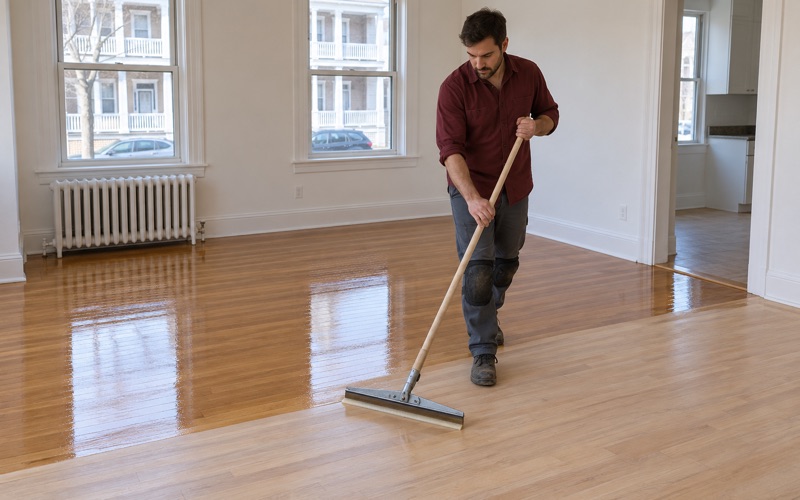
We pick finishes that fit the state’s coating VOC limits for varnish, sealer and lacquer. Waterborne polyurethane dries clear and fast for families who need rooms back quickly, while oil-modified polyurethane warms the color and hardwax oil suits owners who would rather spot-repair than recoat. Stain samples go down on your own boards, in your own light, and water popping helps darker colors take evenly on oak.
Sheen level matters as much as color in a lived-in house. A satin or matte sheen hides the scratches that dogs and kitchen chairs leave, while a gloss shows every one, and we lay sheen samples next to the stain samples so you judge both together.
Weaving In New Boards
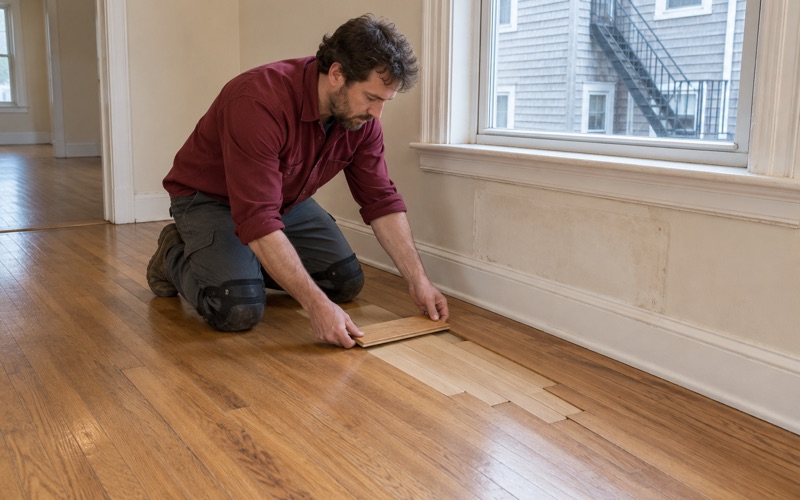
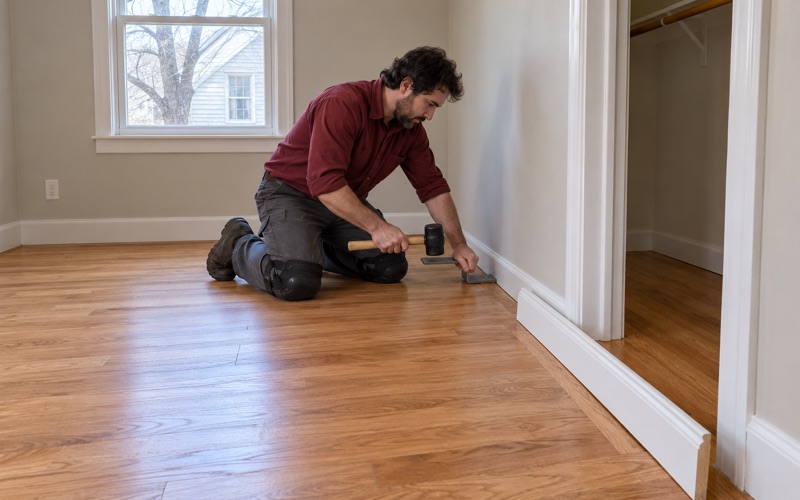
Additions, removed walls and old radiator pipes leave gaps that a patch of mismatched boards makes obvious. We do weave-in repair and board replacement by staggering new tongue and groove boards into the existing rows, matching species, width and grain, so a radiator removal patch disappears under the finish. Orange oak from an older amber finish is usually sanded back first so the old and new boards are judged on bare wood.
Where a wall came out between two rooms, the boards can run the same way but sit at different heights or widths. We feather the transition with new boards rather than a reducer or threshold strip whenever the floors allow it, so the opened room reads as one floor.
Planning a Whole-House Floor Project in Wilmington
Owners often start with one worn room and end up asking about the whole first floor. We plan those projects as one estimate with each room priced separately, so you can do the living spaces now and the bedrooms later without the color drifting between phases.
Stairs, Moisture and Structure
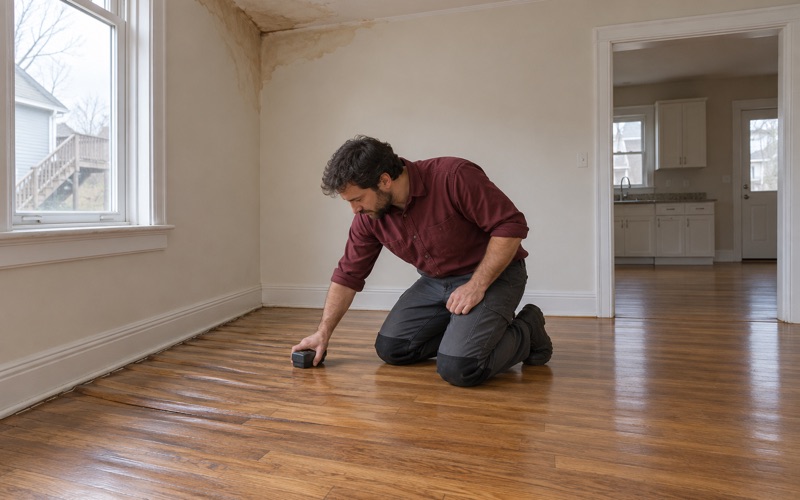
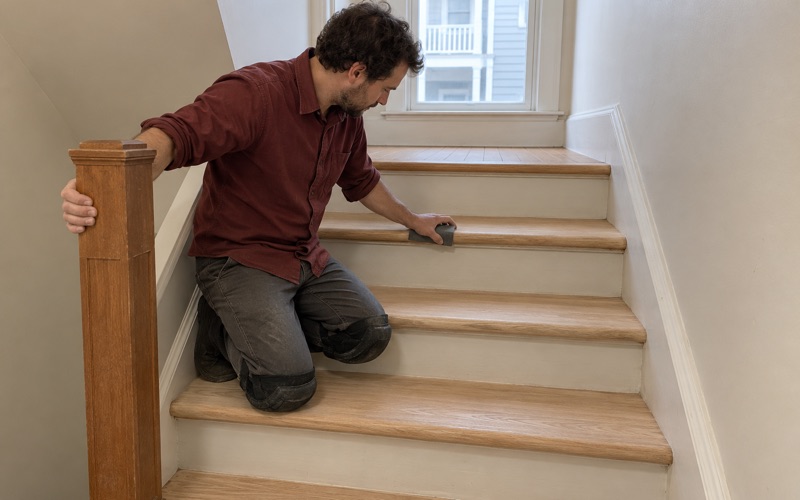
Stairs are quoted tread by tread, since stair treads, stair risers and stair nosing each take hand work that square-foot pricing hides. When water is part of the story, from a burst pipe or a leaking appliance, we trace it, dry it and take moisture meter readings before any board comes out, and we document each affected room for your insurance adjuster. Cupping, crowning, buckling and board gapping tell us what the moisture did, and a bouncy floor or sloping floor that points to the joist or subfloor gets referred to the right trade rather than sanded over.
New Floors in Existing Rooms
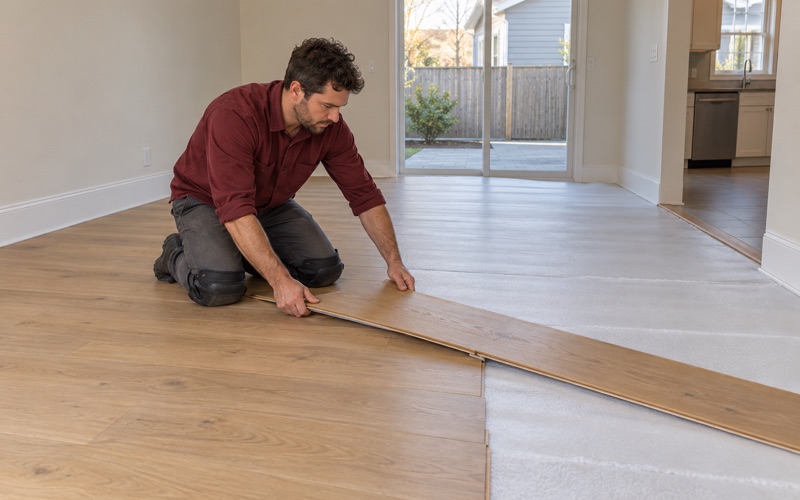
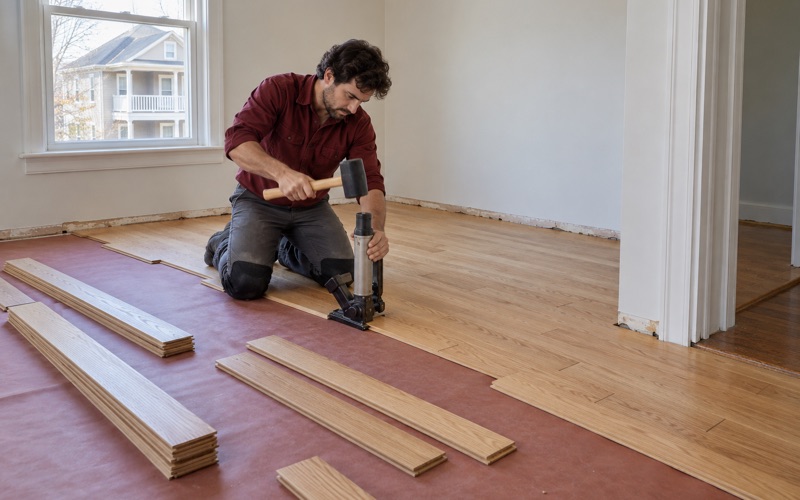
For new installations we follow the NWFA Installation Guidelines on acclimation, expansion gap and underlayment, and we check moisture in the subfloor before solid hardwood goes down. Site-finished floors let new boards match an existing room’s color exactly, while prefinished floors cut the days a room is closed. Any rooms below grade are a case for engineered flooring and a vapor retarder, not solid strips.
Seasonal movement is part of any New England wood floor. Boards shrink in heated winter air and open into winter gaps, then close again as summer humidity returns, so we install and finish with that cycle in mind and tell you which gaps are normal and which point to a moisture problem.
What Your Estimate Covers
Every written estimate lists the rooms, the square footage, the stairs, the repairs and the finish system, with the sheen level named. If we find something under the old floor that changes the plan, such as an unexpected adhesive or soft subfloor, we stop and talk it through before going further. That way a Wilmington homeowner always knows what the next day of work costs and why.
- 20+ Years on Wood Floors
- Itemized Written Estimates
- Old Pine and Oak Work