
Lawrence Wood Flooring has spent 20+ years on wood floor refinishing in Lawrence, MA, serving surrounding cities including Methuen, Andover, Haverhill, Lowell, Boxford. We sand floors back to clean wood, repair the boards that need it and lay down a new finish that fits how the room is used.
Refinishing is not one job done the same way on every floor. Red oak strip flooring, maple and old softwood each sand differently, and a floor with wax, shellac or old glue on it needs that dealt with before a single coat goes down. We read the floor first and quote what it actually needs.
Every quote is written and broken down by room, with stairs priced per step and repairs listed separately. You know which part of the job costs what before anything starts.
Reading the Floor Before Any Sanding
Checking How Much Wood Is Left
A solid hardwood floor can only be sanded so many times before the tongue and groove starts to show. We pull a vent cover or look at a threshold to see how thick the wood is above the groove, because a floor that has been sanded hard in the past may need a lighter touch or a screen and recoat instead.
Engineered boards get the same check. If the engineered wear layer is too thin to sand, we say so rather than sanding through it and leaving you with plywood showing.
Finding What Is on the Surface
Older homes often carry wax residue, a shellac finish or decades of oil-based polyurethane, and some of these will clog sandpaper or refuse a new coat. We test the existing finish so the sanding plan is set for what is really there.
If carpet has just come up, we also look for leftover carpet glue, linoleum glue or black mastic. Mastic stops the job until the right trade has handled it, because it is never something to run a drum sander through.
Confirming the Build Year and Painted Surfaces
Massachusetts runs its own lead-safe renovation rules for homes built before 1978, and painted thresholds, baseboards and stair parts are common in older houses. We ask the build year and note painted surfaces before sanding, so the setup is planned around them rather than discovered after the dust is in the air.
Repairs Made Before the First Pass
Boards with black pet urine stains, deep water stains or split edges are cut out before sanding, not after. We weave in matching boards at staggered lengths so the repair has no straight seam, and then the whole room is sanded together so old and new wood take the finish the same way.
The same goes for holes left where radiators and their pipes came out. A square plug glued into the gap always shows, so we cut back to sound boards and lace new ones into the floor.
Gaps, Squeaks and Loose Boards
Some board gapping is seasonal and closes again in summer, and filling it in winter can crush the edges once the wood swells. We separate seasonal gaps from permanent ones and refasten loose or squeaking boards before sanding, so the new finish goes onto a floor that stays put.
How the Sanding Is Done
Drum Sander, Edger and Orbital Sander
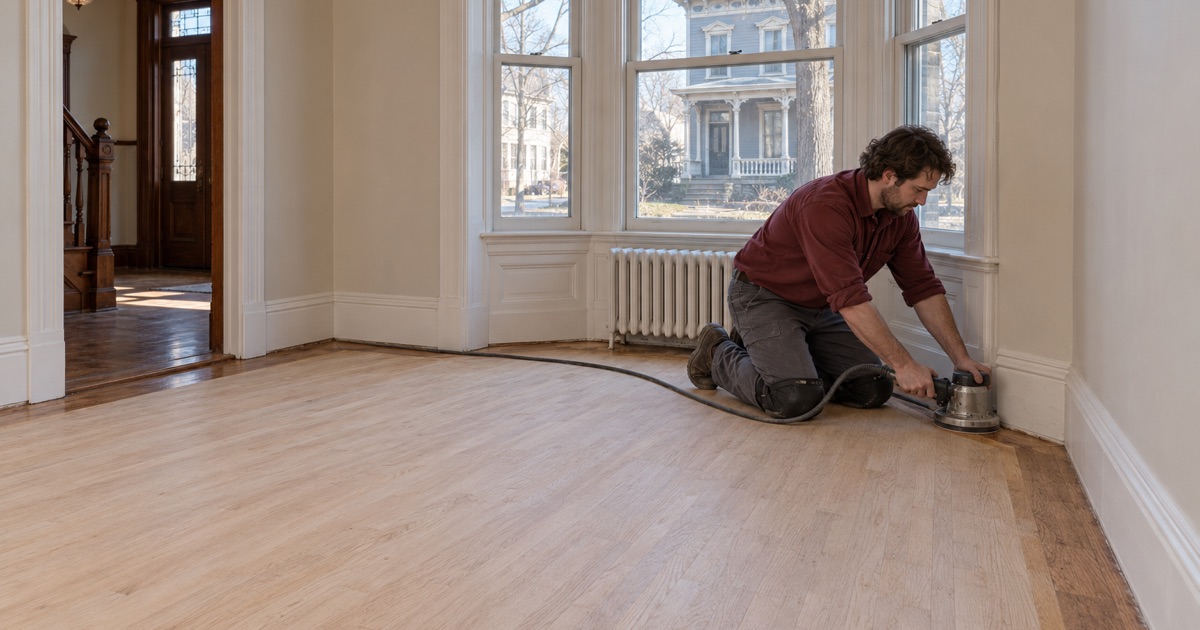
The main field of the floor is cut with a drum sander, the edges and corners with an edger, and the final pass is often done with an orbital sander to take out swirl marks. Each tool leaves its own pattern, and the work is in blending them so the floor reads as one surface under finish.
We keep the drum moving and feather it in and out, because a drum that stops in one place gouges a dip that shows forever once the light hits it.
The Grit Sequence
Sanding works through a grit sequence, starting coarse enough to remove the old finish and stepping up through finer papers until the scratches from each step are gone. Skipping a grit to save time leaves scratch marks that a stain will highlight rather than hide.
Soft woods need gentler grits and lighter pressure than oak. We set the sequence for the species on your floor, not for the floor we sanded last week.
Dust Control While We Work
Our sanders run with dust collection, and we vacuum with HEPA vacuums between passes and before every coat. Doorways are sealed off, and the rooms you are living in stay as clean as possible while the floor is open.
Choosing Color and Finish
Stain Samples on Your Own Floor
A stain color looks different on red oak than on white oak, and different again under north light than under a south-facing window. We sand a small section and lay out stain samples right on your floor, in your own light, before you pick a color.
For darker colors, we may raise the grain first with water popping so the stain takes evenly across the boards. That step is what stops a dark stain from going blotchy on oak.
Natural Oak Instead of Orange Oak
Many floors in this area were finished decades ago with oil-based products that have ambered into orange oak. Sanding to fresh wood and finishing with a clear waterborne polyurethane brings the floor back to a natural tone, while a light stain can warm it slightly without the yellow cast.
Waterborne, Oil-Modified or Hardwax Oil
Waterborne polyurethane dries clear, cures quickly and has less odor, which suits a lived-in house or a rental between tenants. Oil-modified polyurethane gives oak a deeper, warmer color and takes longer to dry between coats. Hardwax oil soaks into the wood and is easier to spot-repair, but needs more upkeep.
Coating products are covered by volatile organic compound limits on both sides of the state line, and those limits line up for varnish, sealer and lacquer. We pick finishes that meet them whichever side of the line your house is on.
Picking a Sheen Level
Sheen level changes how much a floor shows wear. Matte and satin hide scratches, dust and pet traffic, while semi-gloss and gloss show every footprint. We help you match the sheen to the room and how it will be used.
Refinishing Older Floors, Rentals and Two-Families
Oak Found Under Old Carpet
Removing wall-to-wall carpet often uncovers red oak strip flooring that has been hidden for decades, along with the pad, staples and tack strip. We pull every fastener, fill the nail holes and refinish the floor so the room gets its original wood back.
Old Pine and Softwood Floors
Eastern white pine, southern yellow pine and heart pine are far softer than oak, and a crew that sands them like oak scoops out the soft grain and leaves a rippled floor. We run lighter passes and a finer finishing grit on softwood flooring, and we tell you up front that pine will keep its dents and character after refinishing rather than looking like new oak.
Stairs as Part of the Job
When the hallway floor is refinished, the stairs usually need to match it. Treads, nosing and risers are sanded largely by hand and quoted step by step, so you can decide whether to include them now or leave them for later.
Floors in a Two- or Three-Family House
In a two-family or triple-decker, we refinish one floor at a time, so the household on the other floor keeps living there. Dust is contained, the shared stairway stays usable and the loudest sanding is scheduled for reasonable hours.
Rental Floors Between Tenants
For landlords, we plan refinishing around the move-out and move-in dates, so the unit is ready on time. When we see damage beyond ordinary wear, we note it on an itemized written estimate that a landlord can rely on.
When Refinishing Is Not the Answer
A bouncy floor, a sloping floor or boards that keep cupping point to something underneath the finish. We tell you when the problem is structural or moisture-related and refer it out, because a new coat over a failing subfloor only hides it for a season.
- 20+ Years on Wood Floors
- Itemized Written Estimates
- Old Pine and Oak Work